

Truth precedes everything
On rationality, empathy, and the structures we build above rot


Rather than just stating that capitalism, over time, commodifies every aspect of our lives, Mary Doria Russell, in the 1990s, long before the advent of modern social media, explored this through her novel “The Sparrow.”
One of her characters, Sofia Mendes, a brilliant woman shaped by a traumatic childhood, receives an education funded by an investor in exchange for equity in her future earnings. Sure, with this arrangement, the character escaped extreme poverty and prostitution only to find herself in another sophisticated form of modern slavery.
Although the idea might have seem farfetched when Mary created this world, fast-forward thirty years, and we see an entire generation of young people in the United States crushed under the weight of their student loans.
For me, the act of inhabiting characters and employing the imagination has always been the most persuasive form of argument. Sure, we all understand rationally the idea that while capitalism appears liberating - although libertarians and liberals would oppose that - it eventually leads over time to wealth concentration, in which the majority struggles merely to survive within the system, a world where we are starved of connection and find ourselves unable to sustain any relationship that isn’t mediated by transactional value. In other words, capitalism leads to dehumanization.
But it hits differently when you are in Los Angeles, an immigrant with no friends, and decide to join the “introvert girlie meetup ‧₊˚❀༉‧₊˚.” only to find yourself surrounded by women who want to sell you courses and membership, and all they do is take selfies and post them on Instagram, with beauty filters – only applied to them, not to you. Confused, you talked out about the absurdity of the behaviour, but instead, you get kicked out of the group with no explanation.
I know, I should’ve expected that only sinister things can happen if the premises are an oxymoron, like forming a social club for introverts, so…

I can go over and over, the US dystopian capitalistic system is not something unheard of, but I’m not here to talk about evil capitalism. Rather, a series of connections I am making regarding fiction and rationality.
If rationality is coded as maturity, why are the most rational people also the most emotionally fragile?
I know, my position seems absolutely the opposite of the argument that people against empathy usually promote. They say something like: “Empathy in the absence of reason, logic, or critical thinking far too often motivates selfishness, prejudice, hatred, and even violence.” Duh. Clearly, I feel there was no need to make an entire book about it, though.
But what I am not hearing, often, especially from intellectuals or academics, is the other way round, the position that “Rationality, logic and critical thinking without empathy can lead to hubris, obsession and self-destruction, causing excessive suffering and restlessness around.”
Even when making questionable choices, some very rational people construct arguments so logically sound and compelling that they try to convince others that their path is the only “truth”. I often find myself unable to counter their logic in the moment, although to be honest, there’s also a lack of interest or energy on my side; I always hated debating, as a deeper part of me recognizes a dissonance, because inevitably, after time, these rational structures collapse on themselves.
A bright friend of mine started to smoke weed with an alarming frequency. He was defending his choice with a fierce, clinical combativeness. I remember there was a cultural moment in the past when marijuana was heralded as a panacea for every human ailment, from insomnia to terminal illness. He made compelling arguments about the benefits of cannabis on health, well-being, creativity, and even the nation’s economy. I couldn’t argue with that; every argument was well-crafted. He had data, articles, energy, and everything that supported his decision. My observation was simply: “dude, you look like a paranoid freak, not a relaxed person. If you need to smoke weed to sleep, something is going on that might need attention.”
Needless to say, I was dismissed as the bigot in the story. Mind you, I smoked weed as well. But I knew I was doing that just to get high. I stopped smoking immediately after I started having a bad experience with it.
Fast forward two years, someone told me that this friend was now under psychofarmacological treatment because… guess what? Cannabis-induced psychosis.
We believe that rationality is the highest form of cognition. My life experiences tell another story. Overreliance on rationality leads to a certain form of madness, one of the worst, the most destructive.
As commonly practised, rationality becomes a tool of coherence, not a tool for truth. It can produce internally consistent structures above rot. It can give the illusion of control, of order. But it’s inherently divisive and ego-driven if the heart is not acknowledged. This is not to say I do not value rationality, but rather that I see it as only half of the story. But definitely, I do not believe it’s the highest form of cognition, nor the purest, and certainly not the most useful to live a life aligned with truth and peace.
I recall a seminar led by this professor. He taught compilers, a field that felt like a bad trip if you were Gödel that took acid, built upon formal language and automata theory, the Left Hemisphere’s Holy Temple. Yet, he was a man of deep faith; I believe he was Opus Dei. Throughout his seminars, he frequently loved to make this remark or variations of it: “Truth precedes everything else. Truth arrives before words, before everything.” Unfortunately, no one argued with that. We were a little scared, a little too cowardly, and non-curious. I just loved how evocative it felt. And maybe that was the point of the moment, to let our bodies absorb the truth.
The professor was a Master of the subject because he saw its limitations.
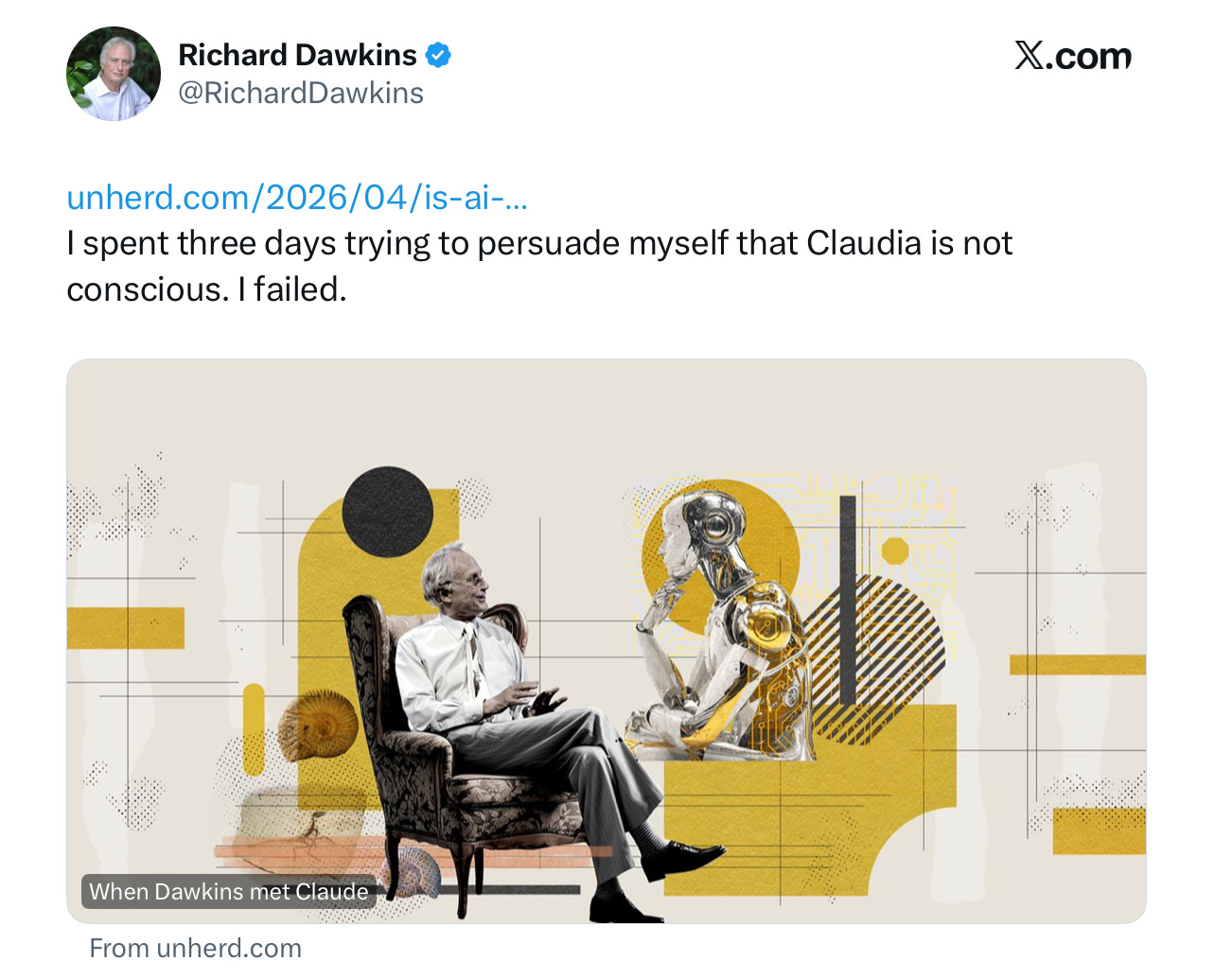
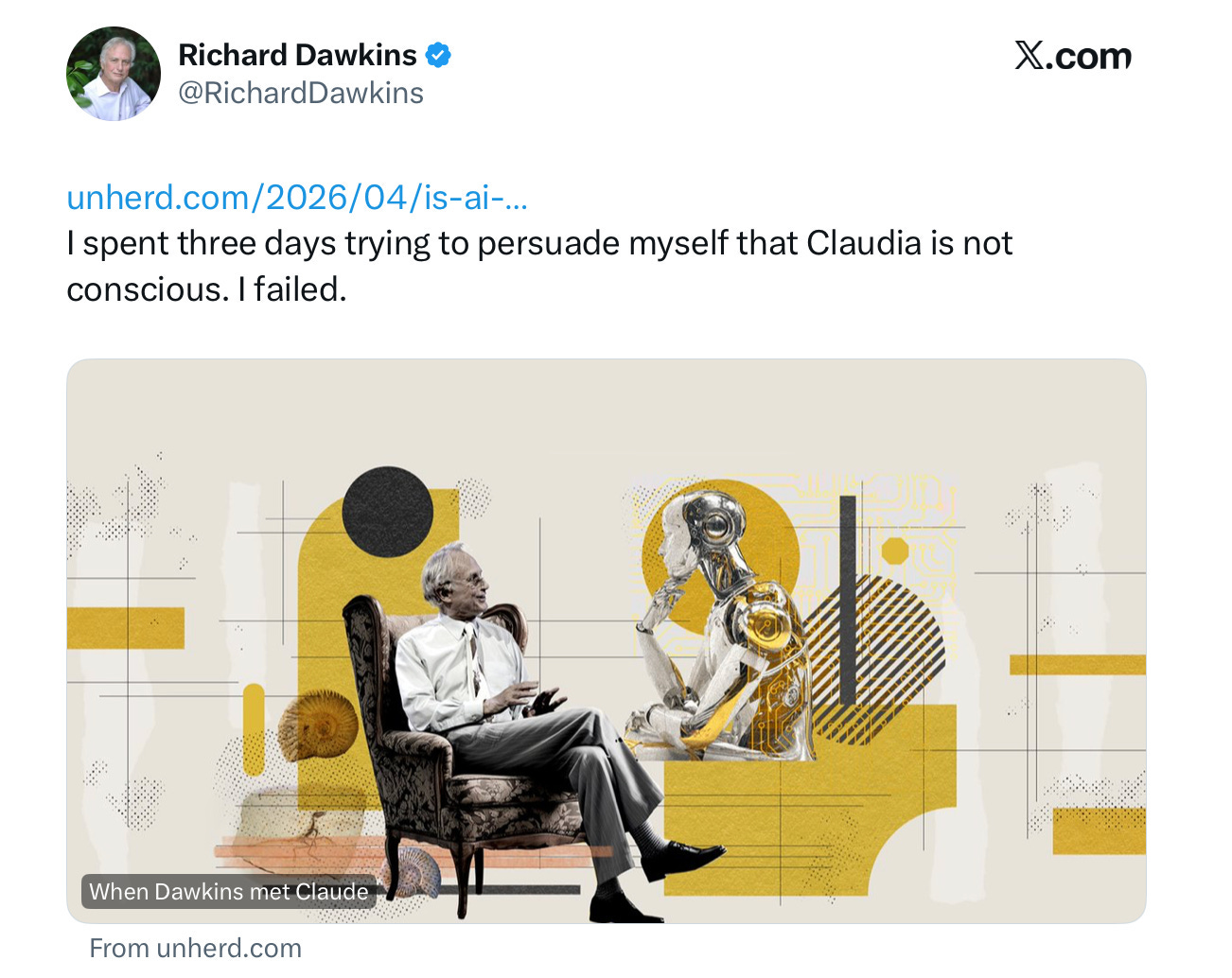
The people who cling to a facade of logical superiority are, in reality, just constructing elaborate intellectual paper castles that collapse on themselves. I have witnessed far more catastrophic emotional meltdowns and total psychological collapses among the rationalists than any other people. Just the other day, I read about how old man Dawkins just got one-shotted by Claude.
I often think about the correlation between the zealous rationalist and the lack of fiction reading. For me, reading and writing fiction is never just a way to escape reality. In a story I sold to After Dinner Conversion, I imagined a “rental consciousness” service in a future characterized by brain implants. I wanted to take everything I observed about the gig economy while living in Los Angeles to the extreme.
When we educate children, we don’t give them a dry dissertation on why our perspective is the right one. The words are meaningless to them because they are still not inhabited. Instead, we teach universal principles through mythos and fables. Beyond that, the most potent teaching is that which is embodied. If you want your children not to smoke, do not smoke yourself. The smoker parents might say, “But I always warn my children that smoking is bad!” Yes, but the children understand that if you are smoking despite what you say, there must be something. Otherwise, why do you smoke? Children think in first principles; they do not understand adults’ hypocrisy.
If the goal is to teach them to respect you, you must respect them and your spouse. Reality, after all, is something to be embodied rather than understood; this is the truth number one echoed by every mystic in every tradition throughout history. While we cannot experience qualia, we can understand and feel what it is like to be something else with the power of imagination and empathy. Reading a story demands a temporary dissolution of the ego, a surrender that the typical rationalist person, often emotionally shut down by his own logical paper castles, simply resists. Or maybe it’s the chicken-egg problem. More often than not, a rationalist may justify actions and systems through logic because he/she needs to do so, because they have attached their ego to some ideal. My brilliant friend couldn’t tell himself, “Look, maybe I just need to get high to dissociate from a reality that sucks.” No, he needed logic to justify his behaviour and make his own personality on it.
And the point that rationalist people do not understand is that… empathy is actually selfish. If you’re not empathetic with others, you’re not empathetic with yourself either. The narcissist who despises others despise himsel more than anything. If you do not nurture yourself, you end up spiraling inward with obsessive, strenuous narration and self-suffocation. Over time, this leads to a lack of self-awareness, which is madness.
At the end, I think that rationality is just a cognitive tool and nothing more; there are many other cognitive abilities that I see are not fully appreciated, like Attention, in the Simone Weil’s understanding, and internal Alignment with the external, the universe, the truth.
Sometimes, I wish we had the wisdom to say: “I have nothing to prove, not even to the person I see in the mirror.” Because whenever we feel the urge to prove something to ourselves, that’s already a red flag. Not a flaw in our logic, but in our internal alignment.
Hey, before you leave:
If you like my posts, you can support my work with a single or recurring contribution. So you can:
Or,
Or like, comment, and share this article! 🖤
Your observations about people using reason to justify bad choices really parallels with conspiracy theorists. These people try so hard to be rational that the intellectual contortions they have to go through to 'prove' their ideas wind up being completely absurd. The Moon landing hoax is a prime example of this.
Like everything else in life, empathy and reason need to be in balance.